
What if protecting yourself from fraud has less to do with recognizing every scam, and more to do with knowing exactly what to do when something feels wrong?
Fraud changes constantly. The pressure tactics behind it do not. The AskAFriend Fraud Defense System gives you a practical way to slow down suspicious requests, verify what you are being told, and decide whether to act, pause, or walk away.
You Do Not Have to Recognize Every Scam
Fraud changes too quickly for anyone to memorize every new scam.
A convincing bank call today may become an AI-generated family emergency tomorrow. A fake investment opportunity may look completely different from a fraudulent job offer, payment request, contractor pitch, or account warning.
But the decision problem underneath them is often remarkably similar.
Someone wants you to act before you have independently verified what you are being told.
The AskAFriend Fraud Defense System gives you a repeatable way to handle that moment.
A System for the Moment Something Does Not Feel Right
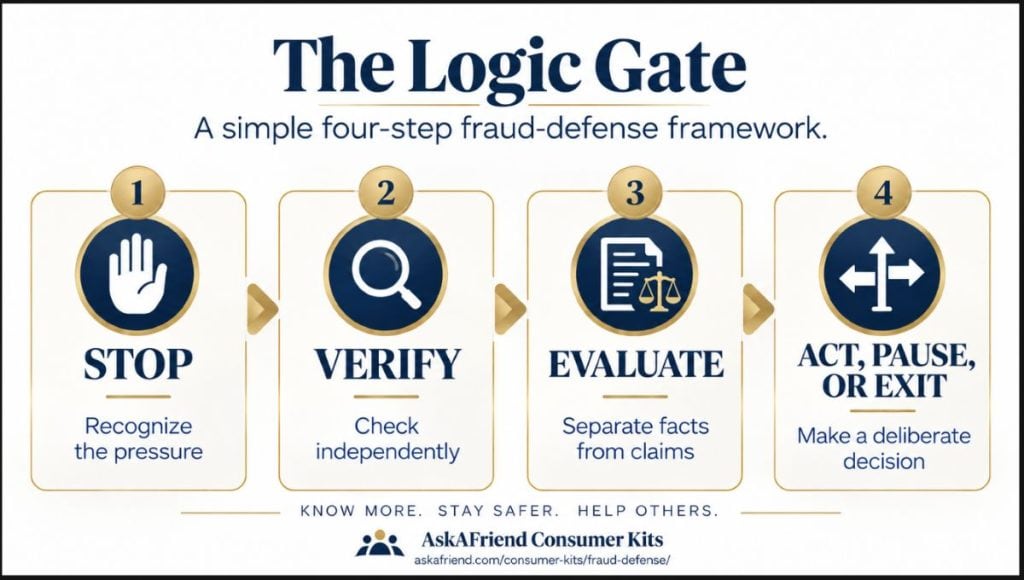
The Fraud Defense System is built around a simple four-step framework:
STOP
Recognize the pressure, urgency, fear, excitement, secrecy, or unusual request and slow the decision down.
VERIFY
Confirm the person, organization, claim, and instructions through a channel you obtain independently.
EVALUATE
Separate what you know from what you have merely been told. Ask what remains uncertain and what you could lose.
ACT, PAUSE, OR EXIT
Proceed through a verified channel, pause while important facts remain unresolved, or end the interaction.
The underlying Consumer Fraud book describes this Logic Gate as a practical decision procedure designed for the moments when people are tired, distracted, frightened, rushed, grieving, or excited, precisely when relying on instinct alone becomes harder.
The objective is not to make you suspicious of everything.
It is to give you a procedure for deciding what deserves verification before you commit money, information, access, or trust.
The Fraud Defense System
The main Fraud Defense System is a self-contained digital package designed for personal use.
It includes:
Fraud Defense Field Guide
A practical guide to the recurring structures behind many scams, common pressure tactics, independent verification, suspicious payment requests, impersonation, account warnings, investment and job offers, and other situations where slowing down matters.
Fraud Defense Workbook
Worksheets that help you assess your current defenses, practice the Logic Gate, identify weak points, plan verification steps, and turn general fraud awareness into concrete habits.
Fraud Scenario Practice Pack
Realistic situations that let you practice the process before you face it under pressure.
Scenarios include suspicious bank contacts, emergency family requests, investment pitches, job offers, payment changes, contractor situations, online transactions, and newer technology-enabled fraud.
Fraud Quick Reference Pack
Compact reference tools you can print, keep nearby, or save electronically, including the Logic Gate and recurring fraud-pattern reminders.
30-Day Fraud Defense Plan
A practical implementation plan that helps turn what you learned into stronger everyday habits over the following month.
Button: Get the Fraud Defense System
Fraud Changes. The Patterns Repeat.
One of the problems with traditional fraud education is that it can become an endless catalog of scam types.
The Consumer Fraud framework instead teaches recurring structures such as:
- authority impersonation
- manufactured urgency
- trust exploitation
- information asymmetry
- exit friction
- verification obstruction
These patterns do not automatically prove that something is fraudulent. They tell you when there is a good reason to stop and independently verify what you are being told. The book specifically treats these recurring patterns as durable recognition tools that remain useful even as individual scam scripts change.
Protect More Than Yourself
Fraud is often a household problem, not just an individual one.
A teenager may respond differently from a parent. An older relative may trust a familiar-sounding voice. One family member may handle the finances while someone else has access to an account or device. Emergency requests become harder to evaluate when everyone is frightened and no verification procedure has been agreed upon in advance.
That is why the Fraud Defense family also includes an optional Household Fraud Defense Kit.
Household Fraud Defense Kit
The Household Fraud Defense Kit helps families turn general awareness into shared procedures.
It includes tools for:
- reviewing household fraud exposure
- identifying important recovery-control accounts
- creating family verification procedures
- handling emergency money requests
- establishing callback and safe-word procedures
- considering vulnerable household members
- running a Fraud Fire Drill
- reviewing defenses periodically
The underlying Consumer Fraud material includes a household fraud audit, communication protocols, digital hygiene, document management, protection for vulnerable household members, and a Fraud Fire Drill designed to reveal gaps before a real event exposes them.
Optional add-on available with the Fraud Defense System.
If Fraud Has Already Happened
Prevention is only part of the problem.
Once fraud is discovered, people may be dealing with lost money, compromised accounts, identity theft, suspicious transactions, unfamiliar credit activity, repeated contact from the offender, or uncertainty about whom to contact first.
The wrong reaction can make the situation harder. People may delete messages, continue talking to the fraudster, send another payment, lose track of who they contacted, or fall for someone promising to recover the original loss.
The Fraud Recovery Command Center is designed for that situation.
Fraud Recovery Command Center
This optional package helps you organize the response rather than trying to manage everything from memory.
It includes:
- First 48 Hours Action Guide
- Fraud Incident Intake Form
- Evidence Preservation Checklist
- Incident Command Workbook
- Chronology and transaction tracking
- Contact and case-number logs
- Deadline tracking
- Loss documentation
- Recovery progress tracking
- response letters and protocols
- What Not to Do After Fraud checklist
The Consumer Fraud book emphasizes containing the problem, preserving evidence, documenting contacts, following an organized response process, and avoiding unsolicited recovery schemes that can victimize someone a second time.
Optional add-on available with the Fraud Defense System.
Who Is This For?
The Fraud Defense System is designed for ordinary consumers and households who want something more useful than being told to “be careful.”
It may be particularly useful if:
- you receive frequent suspicious calls, texts, emails, or payment requests
- you manage household finances
- you worry about increasingly convincing impersonation attempts
- you help parents, children, or other family members with financial decisions
- you have experienced a near miss
- someone in your household has already been targeted
- you want procedures in place before an emergency happens
- you simply want a better way to decide whether an unexpected request is legitimate
You do not need technical expertise, legal training, or previous knowledge of fraud.
What This System Does Not Promise
No checklist, course, book, or security product can guarantee that you will never experience fraud.
The Fraud Defense System does not promise to prevent every loss, identify every scam, recover stolen money, block identity theft, or replace banks, law enforcement, regulators, attorneys, financial professionals, cybersecurity professionals, or other qualified assistance.
It is consumer education designed to help you recognize reasons to pause, verify information independently, organize what you know, document what happens, and make better-informed decisions.
That same limitation is explicit in the underlying book, which distinguishes consumer education from legal, financial, or tax advice and recommends verifying time-sensitive or jurisdiction-specific information through appropriate official or professional sources. Consumer-Fraud_BOOK-7×10.pdfPDF
Based on the AskAFriend Consumer Guide
The Fraud Defense System is based on concepts and practical tools developed in:
Consumer Fraud: Protect Yourself from Scams and the Shadow System
by Owen Walcher
The book provides a much deeper treatment of fraud psychology, identity theft, financial and investment fraud, digital fraud, marketplace fraud, institutional practices, household defenses, recovery, consumer remedies, and emerging threats.
You do not need the book to use the Fraud Defense System.
The toolkit is self-contained.
For readers who want the full reference, the book is available separately as an optional companion.
Button: Explore the Consumer Fraud Book
Frequently Asked Questions
Is this a course?
No. The Fraud Defense System is a downloadable digital toolkit.
You receive practical PDF guides, workbooks, scenario exercises, reference tools, and implementation materials that you can use at your own pace.
Do I need the Consumer Fraud book?
No.
The Fraud Defense System is designed to stand on its own. The book is an optional deeper reference.
Is this only for older adults?
No.
Fraud affects consumers of every age. The toolkit includes situations involving families, online accounts, jobs, investments, payment apps, contractors, purchases, financial institutions, and other everyday transactions.
What if fraud has already happened?
The main Fraud Defense System includes response guidance, but the optional Fraud Recovery Command Center provides a much more complete set of tools for organizing an active fraud response and recovery process.
Can I use this with my family?
Yes.
The main system can be discussed and practiced within a household. The optional Household Fraud Defense Kit adds more extensive family protocols, household auditing tools, and Fraud Fire Drill exercises.
Is this legal or financial advice?
No.
The materials provide general consumer education. Situations involving significant legal, financial, tax, safety, or other consequences may require current information from an official source or advice from an appropriately qualified professional.
Build a Better Fraud Defense Before You Need It
The goal is not to turn you into a fraud investigator.
It is to make one behavior more automatic:
When someone asks for your money, information, access, or trust, slow the decision down long enough to verify what you are being told.
That single habit, backed by a repeatable process and practiced before the pressure arrives, can change the quality of the decision you make next.
Button: Get the AskAFriend Fraud Defense System